Tuesday, 3 December 2019

IIHMR University’s global conference ‘Pradanya 2019’ concludes with a call to support healthcare innovators

The 24th edition of IIHMR University’s annual international conference Pradanya 2019 successfully concluded on 25, 2019. The theme of the three-day event this year was “Future of Healthcare: Globalization, Local Innovations and You.” More than 45 experts from India and abroad in the fields of healthcare, pharmaceuticals, the development sector and allied industries addressed the audiences. They were engaged in six panel discussions organized around sub-themes of the conference such as Using technology to enhance healthcare efficiency; Value-based healthcare and tackling price transparency; New directions in preventive healthcare; Purpose-driven start-up’s and innovation for health impact; and Strategies for effective implementation of SDG’s 2030.
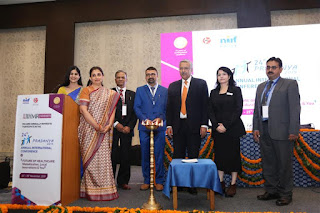


An array of policy makers from states and the Center graced the event with their presence. Some prominent names include Shri Yaduvendra Mathur (IAS), Special Secretary, NITI Aayog; Dr. Sujata Saunik (IAS), Addl. Chief Secretary, Dept of Skill Development & Entrepreneurship, Govt. of Maharashtra; Shri Naveen Jain, Secretary, Dept of Skill, Employment & Entrepreneurship Development, Govt of Rajasthan; Dr. Manish Diwan, Head, Strategic Partnership & Entrepreneurship, Biotechnology Industry Research Assistance Council (BIRAC), Govt. of India; Dr. Nimesh G. Desai, Director, Institute of Human Behaviour & Allied Sciences (IHBAS), Govt. of India; and Dr. Harsh Shah, State Program Manager, National Health Mission, Govt. of Gujarat.


Other participating dignitaries included Dr. Kapil Garg, Director, Paras Hospitals Group, Jaipur; Dr. Sheenu Jhawar, Director, Apex hospital, Jaipur; Dr. Pankaj Gupta, Head-Digital Health, Access Health International; Dr. Narayana Prasad, Director, Public Health Literacy, Boston; Dr. Gaurav Talwar, GM, IBM; Dr. Mala Airun, Zonal Clinical Director, Narayan Multispecialty Hospital; Dr. Sudarshan Jain, Secretary General, Indian Pharmaceutical Alliance; Dr. Rahul Pandey, Operations Officer, The World Bank; Dr. Devendra Khandait, Deputy Director, India Office, Bill & Melinda Gates Foundation; and Dr. Richa Singh Debgupta, Vice President, Fortis Healthcare.


Said Dr. Pankaj Gupta, President, IIHMR University, Jaipur: “Since the last 23 years, ‘Pradanya’ has been focusing on the most relevant and burning topics of healthcare that have immense significance for India and rest of the world. The intellectual churning generated during the event will give a long way in giving all stakeholders and upcoming industry leaders a better understanding of how to effectively meet the gaps in Indian healthcare and prepare it to meet the challenges of the future”.


Pradanya 2019, successfully concluded on 25 November with distribution of awards to deserving students for the research papers and posters submitted on various themes of healthcare. The names of winning students for best papers and posters are given below:


LIST OF WINNERS – Papers and Posters
The names of winning students for best papers and posters given below:

LIST OF WINNERS – Papers and Posters

For PAPERS

Name of StudentCourseUniversityTopic
First Prize
Mayank Chhabra (author)MBA – Hospital Management (1st year)IIHMR – JaipurFabrication of non-invasive paper-based digital health device for early diagnosis of non-communicable diseases
Vinit Yadav (co-author)MBA – Hospital Management (1st year)IIHMR - Jaipur
Second Prize
Atharva Bahad (author)MBA – Hospital Management (1st year)IIHMR - JaipurSolar dis-infection of water to enhance healthcare efficiency
Dr.  Vinay Dureja (co-author)MBA – Hospital Management (1st year)IIHMR - Jaipur
Third Prize
Ms Minal Chawla (author)MBA-Health (2nd year)SVDU VadodraLevel of awareness of government schemes among patients in Dhiraj Hospital
Mr.  Bhavin Zanje (co-author)MBA-Health (2nd year)SVDU Vadodra
FOR POSTERS

Name of StudentCourseUniversityTopic
First Prize
Himadri VermaMBA – Health (2nd year)IIHMR - JaipurImplementation of interventions in CHC Sanganer, Jaipur – value based-healthcare model and Kayakalp parameters
Amritesh MishraMBA – Health (2nd year)IIHMR – Jaipur
Second Prize
Amitoj KaurMBA-HM (1st year)IIHMR - JaipurRadio frequency ablations – an alternative to hysterectomy
Vidushi BhardwaMBA-HM (1st year)IIHMR – Jaipur
Third Prize
Dr. Chaity SarkarMDS (1st year)Maulana Azad Institute of Dental ScienceAssistive m-health technology for mother and child healthcare: An innovative approach
Dr.  Vikrant MohantyMDS (1st year)Maulana Azad Institute of Dental Science

Tuesday, 2 July 2019

IIHMR University alum Prof. Shibu John describes the crucial role of health care managers in the future


“Healthcare managers have a huge role to play in current scenario. They can improve accessibility and affordability of healthcare for the masses and make a big difference,” says Prof. Shibu John, IIHMR University alum. Since completing his Post Graduate Diploma in Health Management in 1998, Prof. John has had a prolific career in industry as well as academia. The Professor at Jamia Hamdard University reveals how the PGDHM paved the way for a satisfying career and what lies ahead for future professionals in the field.

Prof. John started his career as Executive – Project Planning and Coordination with Fortis Healthcare. He asserts that his time at IIHMR University had prepared him for the challenges he would face in the industry. “The strength of faculty team at IIHMR University is unparalleled. Many of them have gained International exposure working with the big players in the healthcare sector including the WHO and UNICEF. Being trained and mentored by them is a huge advantage when you start your career,” he reflects.

According to Prof. John, the faculty team at IIHMR University leads by example. Their work on the ground in the healthcare sector inspires students to be hands on at the grassroot level. He believes this practical exposure along with a holistic learning experience at the university moulds responsible professionals for the healthcare sector. “The University has created an all round encouraging environment for students to realize their potential. Evolving, industry oriented curriculum to well equipped library, everything is geared to transform students into strong health care administrators and managers,” he asserts.

Equipped with the required skills, graduates from IIHMR University make their mark in various roles in the healthcare sector. Talking about the scope in the industry, Prof. John claims that most jobs in the field today have to do with resource management. “Doctors have to offer medical care to a lot of patients, but they have limited resources. So, the industry requires professionals with managerial skills to make optimum and effective use of the resources,” he says reminding future professionals of their crucial role in the industry.

Alum Mr. Gulshan Baweja tells us how IIHMR University laid the foundation for his rewarding career


“In the competitive landscape, the most important attribute for students graduating from management institutes is leadership. When combined with requisite knowledge, leadership qualities can help students make their place in any field they choose,” says Mr. Gulshan Baweja, Founder and CEO, Yuva Healthcare Skilling. The IIHMR University alum batch 1996 – 98 himself went on to gain further credentials from top institutes before building a prolific career in the industry. He breaks down the formula for success in healthcare industry.

INSEAD, ISB are just of the institutes where Mr. Baweja honed his skills. But he knows that things began when he enrolled for his program at IIHMR University, Jaipur. As a part of the first batch, he admits that there were some issues initially, but things sorted out in the second year of the program. “Soon everyone was talking about the change we could bring to hospitals and healthcare sector. It’s almost like a case study of how hospitals are performing efficiently after employing someone from management cadre,” he says proudly.

On an individual level Mr. Baweja believes that his time at IIHMR University was of a complete metamorphosis as he went from being a young student to a well groomed professional with a solid knowledge of the industry. Highlighting the unique aspects of learning at the institute he says, “It is indeed a great institute for learning and the collaboration with Johns Hopkins University gives it an advantage. Nobody else brings that kind of experience and pedagogies to the table to give students the competitive edge.”

According to Mr. Baweja, all graduates of the university carry a proud lineage and legacy. It encourages them to be Champions at everything they do. With the government’s focus on Ayushman Bharat scheme, he believes there will be more avenues and opportunities for new graduates to prove themselves. “Healthcare is multifaceted and includes pharma, providers, technology etc. The government wants to partner with private healthcare providers to provide services to 50 crore people. The sector is opening up and trained managers in the field will lead the way,” he says pointing towards a brighter future.

Friday, 17 May 2019

IIHMR University Embarks On A Celluloid Journey To Uphold The Sanctity Of Climate Change

Mankind is advancing rapidly, a feat that is both beneficial and detrimental for the environment, especially the climate. To throw light on this, IIHMR University Jaipur, in association with Future Health System (FHS), has made a film on climate change and its effect on children. Aptly titled “Children of an Uncertain Climate”, the content of the film is based on “Decoding Child Health Impact under Climate Crisis”, an eminently illustrious study by FHS.

This short film delves into the ways Climate Change is impacting child health in India, keeping in context Sundarbans – a climatically exposed and vulnerable region. The FHS study states that the Sundarbans, the mangrove forest delta shared both by India and Bangladesh is among the worst hit regions of climate change in the world. 

There is no bigger threat to humanity than that of climate change, which is steadily undermining the years of progress made in sustenance and development. Here, the most vulnerable strata come from the children, who would have to bear the brunt of adult’s follies. Hunger and malnutrition are directly linked to the shift in a climate, which in turn creates a disorder in the production cycle. The rise in temperature, water scarcity, and air pollution have joined hands to create an inhospitable scenario where children will face a full-forced impact of both water-borne diseases and dangerous respiratory conditions. Unless addressed and tackled properly, the future that one has envisioned for his/her progeny is about to be at stake.

“India, along with the world, is set to move towards a perilous era, plagued in complications caused by our own short-sightedness. Inter-governmental Panel for Climate Change (IPCC) predicts that loss of snow from the Himalayas will result in a rise in the sea levels and reduce the flow of water into the Ganges, Brahmaputra and Meghna (GBM delta) basins. This threatens to leave millions of people homeless, lacking water, food, or access to basic services like health care”, said Dr Pankaj Gupta, President, IIHMR University.
To embolden the cause, the film “Children of an Uncertain Climate” was shown at the World Conference on Health and Climate Change that took place on 15 – 16 April 2019. Held in Cannes, France, the conference, called the first ever ‘humanitarian COP’, brought together international experts, operations specialists from various national Red Cross and Red Crescent societies, public and private sector decision-makers, researchers, international organizations and members of the media. 

This conference has been created to update the variances in modern scientific research, presenting innovative solutions to take up the biggest public health challenge of the 21st century.
“It’s about time policymakers take the cause of children into consideration while drafting climate change policy, research and action. Evidence suggests that children are most likely to experience adverse health effects caused by environmental factors. WHO states that predictions by the IPCC envisage that changes in extreme weather events, undernutrition and the spread of infectious diseases will increase morbidity and mortality due to climate change by 2030 Therefore, we need to ensure that the specific needs of children form the centre of any climate change policies”, said Dr S.D. Gupta, Chairman, IIHMR University.

The film and the study aim to create a powerful conversation which results in the following proactive measures:
  • Identify climate change as a risk factor for food security, especially in the island pockets where resources are limited
  • Adopt long-term community-led adaptation strategies in the food production system instead of short-term emergency response
  • Build climate-sensitive infrastructure in climatically vulnerable pockets for uninterrupted care services
  • Undertake state-led innovative measures for supplying vegetables and fruits through the Public Distribution System to improve the food availability of the region
  • Undertake strong surveillance to monitor the growth of the children, especially in the worst-hit regions for prompt action on food insecurity at the household level

Tuesday, 14 May 2019

The MBA in Rural Management is different from Traditional Management Programmes (MBA HRM,MBA Marketing,MBA Finance etc.)


In India with more than 60% of population living in villages, the future is as rural as it is global. Our economy is growing rapidly, but still a massive 47% of it breathes in Agriculture. The flagship missions of the state be it in livelihoods entitlements or basic services like health and education or skilling and entrepreneurship are increasingly investing in creating opportunities and careers. For the corporates too this dynamic geography lies at the frontiers of their growth strategies. 
The MBA Degree in Rural Management programme by IIHMR University, equips students with perspectives and competence to play a professional role in the expanding engagement with rapidly changing rural India be it for services and entitlements or diverse sectors of rural marketing ranging from agriculture, handicrafts, services FMCGs. A step up and stand out from the regular management programmes, it is the platform to launch successful careers with top organizations committed to the vast expanse of the country.


Tuesday, 7 May 2019

Why MBA degree in Rural Management has better career prospects than PGDM in HR / Marketing / Finance?


The MBA Rural Management is a unique programme, in addition to traditional management topics such as Human Resource Management, Marketing, Finance, Project Management, Strategic management, Accounting, Quantitative Techniques, Managerial Analysis and Communication, it also provides deep understanding of concept helpful in managing transformations that directly and indirectly impact 68% of population living in 65% of Indian geography.
About 60 per cent of the population still live in rural areas. 47% of our economy is dependent on the Agriculture Sector. Further, Industry and Service sector accounts for 25% and 28% contribution. So, real corporate action is taking place in rural India. The future of corporates lies with tier 2 & 3 areas, which directly require rural specialization to be effective.
The MBA Rural Management strives to provide better understanding of rural population in order to understand human capital based on the fundamental concepts of human resource management. The field understanding and additional rural concepts helps in managing the people well and hiring the right human resource for right job to achieve organization goal. This additional understanding creates student of MBA Rural Management to stand out in the crowd and do better.
All concepts of marking are also covered by the MBA Rural Management in addition to new concepts of rural marketing, agricultural marketing and other specifics of the expanding rural market. Rural orientation allows MBA RM student to market the product and services better and to be a good marketer. This additional understanding creates student of MBA Rural Management to stand out in the crowd and do better.
With huge amount of businesses taking place in rural India has generated demand for finance candidate with understanding of rural society and economy in order to manage the finance well which tries to capture 65% of India. MBA Rural management in addition to fundamental financial management concept also provide knowledge of rural banking and finance, accounting, processes of costing, forecasting and many more. This additional understanding creates student of MBA Rural Management to stand out in the crowd and do better.
Dr. Sazzzad Parvez
School of Development Studies
IIHMR University, Jaipur

Monday, 8 April 2019

Nearly 1 Million Injury Deaths Per Year in India - Dr. Ellen J. MacKenzie


Dr. Ellen J. MacKenzie, Dean JHSPH at IIHMR University

Jaipur, 25 February: “Nearly 1 million injury-related deaths occur in India per year. For every injury death, there are 135 people that are treated and survive and many more that are not registered or not treated. Globally, 83% of all injury deaths occur in Lower Middle Income Countries (LMIC). For every injury, there are 10-50 survivors who sustain temporary or permanent disabilities,” said Dean, Johns Hopkins Bloomberg School of Public Health, USA, Dr. Ellen J. Mackenzie, as she delivered the keynote address at the prestigious P.D. Agarwal Memorial Lecture on the topic “Towards Zero Preventable Death and Disability from Injury: A Systems Approach”. The program was held in association with Bhoruka Charitable Trust (BCT) and IIHMR University at Maharana Pratap Auditorium, Jaipur on February 25, 2019.
Highlighting the disease burden from injuries in India, Dr. Mackenzie further added that a third of burden resulted from Road Traffic injuries with India facing about 250,000 deaths per year. Suicide is an underappreciated cause of death falling under the category of Self-Harm related injuries with a whopping 230,000 deaths per in India. The age group between 15 and 49 years of age comprise two-thirds of the disease burden in the country.
Talking about the status of trauma care in India, a way forward, she said that ‘112’ emergency has only partial coverage, limited to on-seen care and ambulance transport, gaps in definitive hospital trauma care, poor coordination, limited surveillance, among others are the drawbacks of the current Indian healthcare system. Establishing a Regionalized System of Trauma Care is key to getting the right patient to the right level of care in the right amount of time. This can be done by – reliable communications, pre-hospital care, timely triage and transport to the right hospital care, seamless transfer to rehabilitation, among others. Trustee of IIHMR & BCT, Dr. Ashok Agarwal gave an introduction of Late Shri P.D. Agarwal saying, “Shri P.D. Agarwal was a pioneer and visionary philanthropist who considered work his duty.” On the occasion, he also shared several anecdotes about P.D. Agarwal that highlighted his fair-mindedness, magnanimity and altruism which has also been a great source of inspiration to this family, employees and peers.
President of IIHMR University, Dr. Pankaj Gupta said that the visionary P.D. Agarwal believed in creating wealth with not just money but with meaning. He further said that the P.D. memorial lectures have witnessed many eminent personalities in the past and that he is very thrilled to be associated with Dr. Ellen J. Mackenzie this time.
On the occasion, Trustee of IIHMR-U, Dr. S.D. Gupta introduced the keynote speaker and said that this memorial lecture is an initiative to commemorate Late Shri P.D. Agarwal’s contribution to society. The program was followed by a Q&A session where the guests had the opportunity to interact with the panel.